BC Cargo and their Service Providers make every reasonable effort to ensure the accuracy of information on this website. If for any reason the information is not correct BC Cargo and their Service Providers are not responsible for an errors on these pages. Please verify any information in question prior to making a purchase.
BC Cargo and their Service Providers make every reasonable effort to ensure the accuracy of information on this website. If for any reason the information is not correct BC Cargo and their Service Providers are not responsible for an errors on these pages. Please verify any information in question prior to making a purchase.
The easiest way to transport an ATV on a trailer involves using a proper ramp to drive the ATV onto the trailer, securing it with strong, well-placed ratchet straps to its frame, and ensuring even weight distribution, typically with more than half the weight forward of the trailer’s axle. Before driving, double-check the hitch, lights, and straps, and drive cautiously, checking your straps periodically.
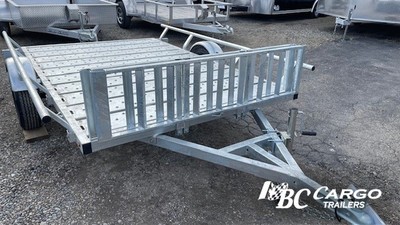
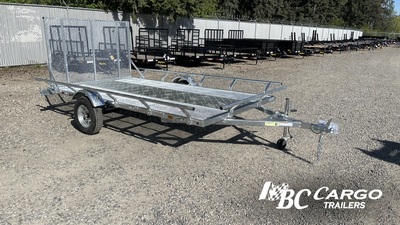
For one ATV, a 5×8 foot or 5×10 foot open trailer is often sufficient, but a 6×10 or 5×12 foot trailer provides more space for gear or larger ATVs. For two ATVs, consider a 6×12, 7×12, or a 14-foot trailer to allow for easier loading and tie-down space. Always check your specific ATV’s dimensions and choose a trailer that is at least 6 inches wider and 12 inches longer than the machine(s) to ensure safe maneuvering and securement.
All trailers should have a VIN plate attached, this plate has the Tare weight and GVWR recorded on Yes, many ATVs are equipped with or can be fitted with trailer hitches, most commonly a receiver hitch, which allows them to tow trailers or other implements. While not always included standard, ATVs designed for farms, ranches, and off-road use can have their towing capabilities extended by adding these hitches to haul equipment or transport cargo. Different types, like receiver, ball, and pin hitches, are available depending on the specific needs of the user.it. Subtract the Tare from the GVWR and the remaining amount is the maximum load weight. E.g. GVWR 1356kg – Tare: 275kg = 1081kg Maximum Load
To properly tie down an ATV on a trailer, you should secure straps to the ATV’s frame or solid suspension components and use four tie-down points, two on the front and two on the back, connecting them to secure points on the trailer. The straps should be tightened enough to slightly compress the front suspension but not to the point of damage, allowing the machine to “float” over the road while preventing movement. Avoid using plastic or rubber parts, bumpers, or axles as tie-down points.
A single-axle trailer’s weight capacity depends on the Gross Vehicle Weight Rating (GVWR) listed on its VIN tag, which includes the trailer’s empty weight plus its maximum cargo capacity. While axles themselves can range from 1,000 lbs for a 1.5-inch diameter to 10,000 lbs for a 5-inch diameter, the trailer’s frame, tires, suspension, and manufacturer’s design also influence its overall load capacity, with most standard single-axle utility trailers holding between 2,000 and 5,000 pounds.