BC Cargo and their Service Providers make every reasonable effort to ensure the accuracy of information on this website. If for any reason the information is not correct BC Cargo and their Service Providers are not responsible for an errors on these pages. Please verify any information in question prior to making a purchase.
BC Cargo and their Service Providers make every reasonable effort to ensure the accuracy of information on this website. If for any reason the information is not correct BC Cargo and their Service Providers are not responsible for an errors on these pages. Please verify any information in question prior to making a purchase.
The maximum weight limit for a tandem axle trailer in Canada is not a single, fixed number; it varies by province and depends on the axle spacing and tire type, but a common standard is 17,000 kg (37,479 lbs) for a tandem axle group when the axles are spaced appropriately and dual tires are used. Other factors that can affect the limit include the type of tires (single wide-base tires can allow for lower weights), whether the axles are load-equalized, and whether there are special permits or provincial variations.
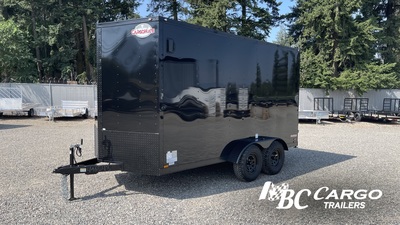
There isn’t a true difference: a tandem axle is a dual-axle system where two axles are placed in close proximity and share a common suspension, often with two tires on each side for a total of four wheels per end. Therefore, “tandem axle” describes the arrangement (two axles close together), while “dual-axle” can refer to the entire two-axle configuration.
A dual-axle enclosed trailer’s weight capacity, or payload capacity, varies significantly depending on the trailer’s specific axle rating and construction, but generally ranges from 7,000 to 14,000 pounds or more. You must check the trailer’s official Gross Vehicle Weight Rating (GVWR) and subtract the trailer’s own empty weight to determine its actual carrying capacity.
The main advantages of a tandem axle trailer are increased stability and a higher payload capacity due to better weight distribution, offering safer and more reliable towing for heavier loads and longer distances. You also get improved braking with more wheels, and a reduced risk of disaster from a single flat tire, as the other axle provides support.
To find your trailer’s axle weight limit, or Gross Axle Weight Rating (GAWR), first check the manufacturer’s data plate or sticker, typically on the trailer’s frame or tongue. If the plate is missing or unreadable, you can often find the information in the owner’s manual or by measuring the axle diameter and referring to a chart of standard capacities.